Orchestration
You do not have an integration problem.
You have an orchestration problem.
After the diagnostic: a precise map of where coordination fails — and a path to an orchestration layer that holds.
MTNA designs, builds, and operates orchestration systems for organizations that need to connect platforms, workflows, APIs, data, and decision environments into one usable operating layer.
Orchestration is not a connector map and not a technical afterthought. It is the coordination logic that allows enterprise capability to function across systems, applications, workflows, data flows, and increasingly AI-supported environments. MTNA works at that deeper layer - engineering orchestration systems that turn disconnected platforms into governed, operationally usable structures.
Orchestration thesis
Enterprise systems fail when coordination remains fragmented, implicit, and ungoverned.
Modern organizations rarely break because systems do not exist. They break because systems do not work together in a coordinated, governable, and operationally usable way. APIs exist, tools exist, workflows exist, and automation often exists - but the connective logic between them remains brittle, opaque, or overly dependent on workaround behavior.
MTNA approaches orchestration differently. We design for explicit coordination first: system-to-system logic, workflow structure, control boundaries, oversight, and the architecture required to move from fragmented operations to usable enterprise flow.
Orchestration is what turns disconnected capability into a working enterprise system.

Where orchestration pressure
becomes visible.

System sprawl without coordination
Platforms, applications, and tools exist across the organization, but they do not operate as one usable system.

Workflow logic hidden in workarounds
Critical coordination depends on manual steps, undocumented routines, or fragile handoffs between teams and systems.

API connectivity without operating structure
Interfaces exist, but the logic governing how information moves, triggers action, and remains controlled is weak or missing.

AI without runtime oversight
AI-enabled processes are introduced before control boundaries, human review logic, and governance conditions are properly engineered.
What MTNA builds.
MTNA works on the orchestration layer that connects platforms, workflows, data movement, and operational logic into one governed enterprise system - not as isolated integrations, but as the connective structure that makes capability usable over time.
01
System-to-system orchestration
Designing the logic that allows enterprise platforms and applications to work together as one coordinated environment.
02
API-led integration logic
Building structured interface and routing logic so connectivity becomes usable, governable, and operationally durable.
03
Workflow and process coordination
Engineering the flow of actions, approvals, signals, and decisions across human and system boundaries.
04
Data-source orchestration
Ensuring that information moves coherently across systems, environments, and operating layers without creating new fragmentation.
05
Cross-platform activation
Connecting enterprise systems so intelligence, workflows, and execution can move across the environments where work actually happens.
06
Application-layer integration
Building the connective structure that allows content, commerce, service, intelligence, and AI-supported systems to function as one working whole.
How it connects
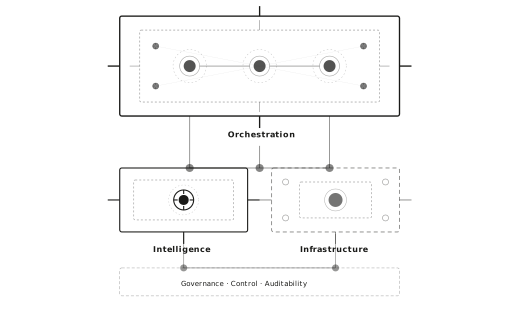
Orchestration is where infrastructure, intelligence, and action become one operating system.
Orchestration sits across the enterprise layer where systems, workflows, data, and decisions have to move in coordinated ways. Infrastructure provides the stable architectural condition. Intelligence provides the owned signals and decision inputs. Orchestration makes both operational - structuring how information travels, how actions trigger, how exceptions are handled, and how control is maintained across the whole environment.
When orchestration is properly engineered, complexity becomes more usable, governance becomes more real, and AI becomes operable instead of experimental.
Selected proof.
All evidence
Orchestration · Corporate Retail · Architecture · Governance · Multi-market · Southeast Asia
Efficiency cannot be optimized into a system that was never orchestrated.
How a corporate retail operation restructured its orchestration layer for enterprise-scale performance
The visible problem was operational inefficiency. The deeper problem was that coordination logic had never been designed. A corporate retail organization operating across multiple markets in Southeast Asia had grown its orchestration environment through accumulated decisions — none of which had been engineered as a coherent system.
View evidenceEntry point
Start with an
orchestration diagnosis.
The diagnostic creates the coordination picture needed to understand how systems, workflows, APIs, oversight logic, and AI readiness currently operate across the enterprise. It does not begin with isolated integrations. It begins with the operating logic between systems.
Most organizations trying to scale automation or AI have never built a real picture of the orchestration layer they are depending on.
Enterprise Orchestration & AI Readiness Diagnostic
The coordination foundation for governed enterprise execution.
A structured assessment of your current system landscape, integration logic, workflow coordination, governance gaps, human oversight needs, and AI-readiness conditions. It produces a clear picture of how your organization currently operates across systems - and what must be engineered to move from fragmented flow to governed orchestration.
Current-state orchestration picture
A structured view of how systems, workflows, and coordination logic currently operate across the environment.
Control and dependency map
The weak points, handoff risks, hidden coordination gaps, and governance pressure areas that are limiting usable scale.
Target-state orchestration direction
A realistic path toward a more governed, integration-ready, workflow-capable operating layer.
AI-readiness and oversight view
A grounded assessment of whether current orchestration conditions can support governed AI use in practice.
From the studio.
All insightsEnterprise flow needs
stronger orchestration
behind it.
If systems, workflows, and oversight remain fragmented, automation and AI become harder to govern and harder to trust. MTNA helps organizations build the orchestration layer first - so coordination, control, and enterprise-safe execution can become structurally real.