Intelligence
Data does not become intelligence on its own.
It needs ownership, structure, and trust.
After the sprint: clarity on where your data breaks down — and a structured path to decision-ready intelligence.
MTNA designs, builds, and operates owned data cores and decision systems for organizations that need stronger visibility, better decisions, and a reliable foundation for enterprise intelligence.
Intelligence is not a dashboard layer, a reporting output, or a thin AI wrapper on top of fragmented systems. It emerges when data is structured, owned, connected, and usable across the organization. MTNA engineers data cores, analytical foundations, signal integration, dashboards, decision systems, and governed AI environments that turn fragmented information into usable intelligence.
Intelligence thesis
Intelligence fails when data remains fragmented, unowned, and structurally weak.
Most organizations already have data. What they lack is control over how it is structured, connected, governed, and turned into useful intelligence. Reporting exists, dashboards exist, and AI ambitions often exist — but the foundation remains weak. Ownership is unclear. Definitions drift. Signals stay disconnected. Decision systems remain shallow.
MTNA approaches intelligence differently. We start with ownership, data-core clarity, signal integration, and governed decision systems that teams can trust and use.
Intelligence is not what appears at the surface. It is what becomes possible when the data foundation underneath it is truly owned.

Where intelligence pressure
becomes visible.

Disconnected reporting landscapes
Dashboards exist, but the underlying logic is fragmented, inconsistent, and difficult to trust.

Unclear data ownership
Critical information moves across teams and systems without clear accountability, definitions, or structural control.

Data without decision value
Large volumes of data are collected, but little of it becomes usable intelligence for real operational decisions.

AI without a real data core
AI initiatives are expected to create value before the organization has built the foundations required to support them.
What MTNA builds.
MTNA works on the intelligence layer that turns fragmented information into trusted data and decision systems — not isolated dashboards or reporting outputs, but a foundation teams can use across the organization.
01
Data cores
Designing owned enterprise data structures that create clarity, consistency, and long-term control across the intelligence environment.
02
Data engineering foundations
Building the ingestion, modeling, and transformation logic required for stable and governable intelligence environments.
03
Intelligence systems
Creating analytical and decision-support systems that make enterprise data easier to interpret and use.
04
Dashboards and decision layers
Translating structured intelligence into environments that support better decisions, not just more reporting.
05
Predictive and market intelligence
Extending the intelligence layer toward forecasting, pattern recognition, and external-signal visibility where the use case supports it.
06
Signal integration
Connecting fragmented internal and external data signals into one more coherent enterprise picture.
How it connects
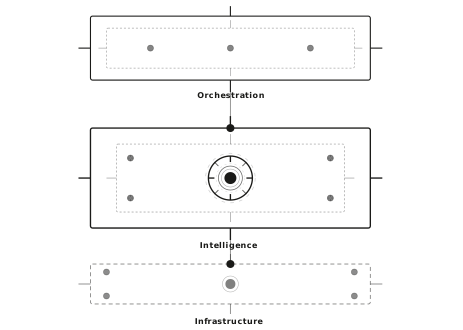
Intelligence is where infrastructure becomes visibility and orchestration becomes usable action.
Intelligence sits between the architectural foundation and the operational coordination layer. Infrastructure enables reliable data movement. Orchestration determines how intelligence reaches systems, workflows, and decision points. MTNA connects those layers by turning data into trusted, usable intelligence for both human decisions and governed AI systems.
When intelligence is properly engineered, visibility improves, decision quality rises, and AI becomes more than experimentation.
Selected proof.
All evidence
Intelligence · Meta · LinkedIn · GA4 · Sprinklr · Snowflake · Dashboard Layer · DACH
The data was there. The problem was that none of it was comparable.
How fragmented marketing signals became decision-ready intelligence
The visible problem was reporting. The deeper problem was interpretation. A global textile, fiber, and ingredient brand operating in the DACH region was producing signals across paid, organic, sentiment, journey, and experimentation environments — but those signals were not comparable enough to support confident decisions.
View evidenceEntry point
Start with a
data-core diagnosis.
The sprint creates a clear view of how data is owned, structured, connected, and used across the organization — including quality, reporting, integration readiness, and AI readiness. It starts with the data foundation behind the dashboards.
Most organizations trying to scale intelligence lack a reliable view of the data foundation they depend on.
Data Core Maturity Sprint
The intelligence foundation for better decisions and governed AI readiness.
A focused assessment of your data landscape — ownership, architecture, integration quality, reporting, and AI readiness. It shows where the current foundation is weak and defines a practical path toward an owned, governable enterprise data core.
Current-state intelligence picture
A structured view of the existing reporting, data, and signal environment as it actually operates.
Ownership and quality map
The gaps in responsibility, consistency, integration, and reliability that weaken decision quality.
Data-core direction
A realistic path toward a more owned, governable, and decision-ready intelligence foundation.
AI readiness view
A grounded assessment of whether the current intelligence layer can support governed AI use in practice.
From the studio.
All insightsBetter decisions need
stronger intelligence
beneath them.
If the data foundation is fragmented, every dashboard, model, and AI initiative becomes harder to trust. MTNA helps organizations build the intelligence foundation first — so data becomes easier to trust, decisions become clearer, and AI can operate on stronger foundations.