Infrastructure
The platform was never the problem.
The architecture was.
After the audit: a working architecture map, every dependency visible, and a phased path you can act on.
MTNA designs, builds, and operates composable infrastructure for organizations that need to reduce fragmentation, stabilize core environments, and create the conditions for durable modernization.
Infrastructure is the structural layer beneath enterprise change. When architecture is brittle, disconnected, or overloaded with legacy logic, modernization slows, integration multiplies complexity, and intelligence has nowhere stable to land. MTNA works at that deeper layer - engineering the foundations that make enterprise systems usable, adaptable, and governable over time.
Infrastructure thesis
Modernization fails when the
structure beneath it stays fragmented.
Most failed modernization efforts do not fail because the platform choice was wrong. They fail because the underlying architecture remains brittle, fragmented, or incoherent. New layers are added on top of unstable foundations. Integrations multiply. Dependencies remain hidden. Delivery slows down while complexity increases.
MTNA approaches infrastructure differently. We design for structural clarity first: architectural coherence, composable foundations, integration readiness, and governed change over time.
Infrastructure is not the background. It is the condition that determines whether transformation can hold.

Where infrastructure pressure
becomes visible.

Fragmented architecture
Too many loosely connected systems, overlapping logic, unclear ownership, and brittle dependencies make the environment harder to evolve with each new initiative.

Modernization without structural redesign
New platforms are introduced, but the underlying architectural condition remains unchanged - so complexity is moved, not resolved.

Integration overload
Each new requirement adds another workaround, connector, or custom layer, increasing coordination effort instead of reducing it.

Weak foundations for intelligence and AI
Data, orchestration, and decision systems are expected to scale on infrastructure that was never designed to support them.
What MTNA builds.
MTNA works on the infrastructure layer that makes enterprise systems viable over time - not as isolated technical workstreams, but as the architectural foundation for modernization, intelligence, and orchestration.
01
SAP modernization
Restructuring architectural conditions around SAP environments so modernization becomes controlled, staged, and strategically usable.
02
Platform architecture
Designing the structural logic of enterprise environments so systems, applications, and dependencies work as part of a coherent whole.
03
Composable systems
Building modular, adaptable foundations that reduce rigidity and allow change without multiplying technical debt.
04
Application foundations
Creating stable architectural conditions across content, commerce, service, and intelligence environments.
05
Integration-ready environments
Ensuring the infrastructure layer can support orchestration, APIs, and cross-system coordination without constant workaround logic.
06
Platform rescue and stabilization
Intervening in brittle or underperforming environments where structural problems are already slowing delivery and increasing risk.
How it connects
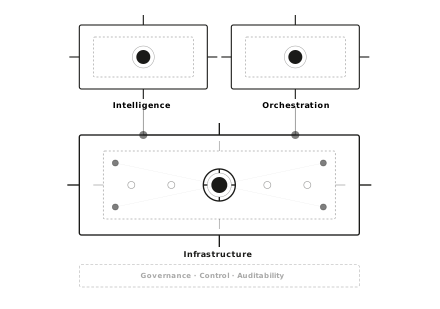
Infrastructure is where Intelligence
and Orchestration begin to hold.
Infrastructure is not separate from the rest of the MTNA model. It is the layer that allows the other layers to function. Intelligence requires stable architectural conditions, real system ownership, and coherent data movement. Orchestration requires environments that can support API logic, workflow coordination, and cross-system control without collapsing under accumulated complexity.
When the foundation is engineered correctly, intelligence and orchestration can become durable enterprise capability.
Selected proof.
All evidence
Infrastructure · SAP ERP · SAP CDC · Storyblok · AI Integration · Governance · Manufacturing · LATAM & US
When the entire organization runs on one system, nothing can move safely.
How a monolithic SAP environment becomes a composable, AI-ready enterprise architecture
The visible problem was the monolith. The deeper problem was that the entire organization was hostage to it. A manufacturing organization operating across LATAM and the US needed to move away from a singular SAP system — without destabilizing commerce data, customer identity, content delivery, or the AI capabilities waiting to be introduced.
View evidenceEntry point
Start with a
structural diagnosis.
The audit creates the architectural picture needed to make decisions about modernization, platform change, or structural investment. It does not begin with assumptions - it begins with the environment as it actually exists.
Most organizations trying to modernize have never had a clear picture of what they are actually working with.
SAP / Composable Architecture Audit
The structural foundation for every modernization decision.
An engineering-led assessment of your current platform architecture - mapping dependencies, release bottlenecks, migration risk, architectural fragmentation, and the target-state path toward a composable operating foundation.
Current-state architecture picture
A structured view of the landscape as it actually operates - not as it was designed to.
Dependency and risk map
The bottlenecks, weak points, and transition pressure areas that are slowing change.
Target-state direction
A realistic architectural path toward a more composable, integration-ready environment.
Phased modernization logic
A practical sequence for moving from brittle structure to durable capability.
From the studio.
All insightsSystem Note
Composable systems are not modular by default
Modernization needs
stronger structure
beneath it.
If the architecture is fragmented, every new initiative becomes harder to scale. MTNA helps organizations rebuild the foundation first - so change becomes structurally possible, not just strategically intended.